Posts

Showing posts with the label Crete

"Cretan Leather" (tsagaris) Cretan maker of boots - article published in The Athenian, 1992

Image
  CRETAN LEATHER by Ann Elder, published in The Athenian, December 1, 1992 " The tourist explosion based on charter flight holidaymaking in western Crete in the last decade is significantly prolonging the life of the traditional Cretan leather industry. Custom-made boots and shoes and handmade sandals, bags and belts from vaketta (treated leather), tanned with natural, environment-friendly products are now being carried or walked on throughout the world by customers who have patronized of Chania’s Carnaby Street – Stivanadika, or Leather Lane. “European women love my Cleopatra sandals,” says extrovert Lefteris Pirpinakis, a master craftsman married to a Frenchwoman. Enjoying the stimulation of summer visitor traffic, he no longer has to burn the midnight oil as he did when an apprentice, sometimes working till dawn to finish orders on time. He produces stylish boots for women, working and riding boots, made-to-measure in a week. The dethroned (but still well-shod) king of Greece i...


Book on Sfakia, Crete: Tradition in the Frame - Photography, Power, and Imagination

Image
Book  TRADITION IN THE FRAME:  Photography, Power, and Imagination in Sfakia, Crete by Konstantinos Kalantzis Published by Indiana University Press, August 2019 Description: Sfakians on the island of Crete are known for their distinctive dress and appearance, fierce ruggedness, and devotion to traditional ways. Konstantinos Kalantzis explores how Sfakians live with the burdens and pleasures of maintaining these expectations of exoticism for themselves, for their fellow Greeks, and for tourists. Sfakian performance of masculine tradition has become even more meaningful for Greeks looking to reimagine their nation's global standing in the wake of stringent financial regulation, and for non-Greek tourists yearning for rootedness and escape from the post-industrial north. Through fine-grained ethnography that pays special attention to photography,  Tradition in the Frame  explores the ambivalence of a society expected to conform to outsiders' perception of th...

History of Cretans in Utah - Minos Society

Image
THE MINOS CENTURY CELEBRATION AND HISTORY OF CRETANS IN UTAH Authored by TNH Staff Published in The National Herald - June 2, 2018 (Note:  HGG has the permission of The National Herald to reprint articles that may be of interest to our group.) ----- SALT LAKE CITY, UT – The Cretan community of Utah will host a commemoration of the 100th anniversary of the formal establishment of their local Cretan organization, the Minos Century Celebration, June 1-3.  Minos Chairman Dr. Tony Gianoulis told The National Herald that “the Cretan community in Utah has a very large presence. Many Cretans came to Utah at the turn of the 20th century to work in the copper mines. As the years went by, more and more Cretans immigrated to Utah and established their families, homes, and businesses here. Today, we are one of the largest Cretan communities in the United States. Moreover, we are proud of the fact that Utah had the first organized Cretan club in all of the Uni...

Christmas Traditions in Crete and Greece

Image
CHRISTMAS TRADITIONS IN CRETE AND GREECE Christmas in Greece, or "the holidays," are not what they were 40 years ago. Over the years we notice a universal culture developing as the western European customs spread more and more change. In some cases, it caused the elimination of local customs in certain areas - even entire countries. Today Christmas in Greece appears more impressive, glossier and more glamorous. Store windows are decorated almost a month in advance, and in the cities the streets and town squares are lit with colourful lights. Also, many people now travel either abroad or around Greece to places which offer winter holidays. Greeks will party at clubs, at bouzoukia, which have almost disappeared in Crete, or stay at home and watch some impressive holiday show on television. But on Christmas Day, all family members gather at the festively set dinner table. The name days of Manolis or Emanuel or Manos or Emanuela are all celebrated on Christmas Day, an...

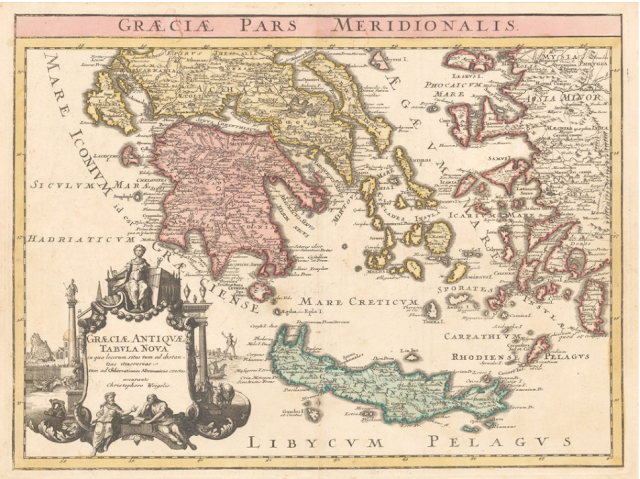
1720 Map of Greece and Crete - Gracia Pars Meridonalis

Image
I found this map available through Harlan J. Berk, Ltd - https://www.hjbmaps.com/products/antique-map-greece-turkey-weigel-1720 1720 Gracia Pars Meridonalis by Christopher Weigel Published 1720 Nuremberg " This is an authentic antique map of Greece, Crete and Turkey. It was published in Nuremberg for the atlas Descriptio Orbis Antiqui in XLIV in the year 1720. This map shows historic cities including Athens, Thebes and Sparta, while the colored outlines represent political divisions. It also features an impressive cartouche, which touts an enthralled goddess and debating scholars."

Deserted Villages of Crete - Village of MOUSSI (MOUSSES)

Image
published in CretanBeaches.com Near the villages of Episkopi and Mourtzana, in a lush green valley, we still see the ruins of the houses and the watermills of the village Mousses or Moussi. In this village we meet the five watermills that took advantage of the abundant water of the area for grinding grain of the surrounding villages. The mills operated till the 1950s, when the modern technology surpassed the traditional way of grinding. Thus, the millers who saw their job diminishing, had to leave this wonderful place and seek their future elsewhere. The village houses were supplied with running water, which is very special for their time, while there was also a grocery store. In the center stands the well preserved church of the Holy Cross (TImios Stavros). The feast of the Holy Cross on September 14 is an excellent opportunity for locals to meet here. The temple is very old, as the entrance still preserves and inscription of 1843 for its renovation, thus it was already very ...

Deserted Villages of Crete - Village of AGIOS IOANNIS LOUSESTRO

Image
published in CretanBeaches.com During the Venetian era, according to oral tradition, there were three rich nobles from Sitia that  moved to the west end of Lasithi, in the province of Mirabello. They founded three small villages, one for each of them. Noble named Fiorentzis built the current settlement of Fioretzides by Lakonia. Demetzos (De Metzo) founded the village Agia Pelagia. Katrinis built Lousestro. Lousestro or otherwise Agios Ioannis gets its name after the hill Loutsi near the village which is taken after the Latin lux, meaning light. Lousestro belongs to the former community of Limnes and is currently almost deserted with only two elderly residents. Almost all villagers were named Katrinis after their founder. The second name, St. John comes from the village temple dedicated to St John Chrysostom. Shortly after the temple at the entrance of the village we meet one of very common cisterns of the area of Pano Mirabello for storing rainwater. In the same area we ...

Deserted Villages of Crete - Settlement of DIO PRINI

Image
published in CretanBeaches.com Dyo Prini (Two Oak trees) is one of the beautiful abandoned villages of Crete, where you think that time has frozen. The area is surrounded by oak trees, as its name implies, and is located close to Limnes village, Agios Nikolaos Municipality, on the road heading to Kalos Lakkos. There are several collapsed stone cottages, some of which have been restored lately. There are many water tanks and threshing plateaus. There are many more abandoned settlements around, such as Agia Pelagia, Drakos, Kalos Kalos, Atzibraga, Renaido and Lousetro. To view photographs of the village -  https://www.cretanbeaches.com/en/tradition/architecture/abandoned-settlements-villages/dio-prini-ruined-village

Deserted Villages of Crete - Village of CHANDROU (Handrou)

Image
published in CretanBeaches.com Shortly after the village Mousouta there is the deserted village Handrou. This is another unknown beautiful Cretan village that once throbbed with life but today looks haunted, with only one resident. The village is situated in a prominent location with beautiful views and is surrounded by two streams. There is the two-aisled stone church of the Holy Apostles and St. John the Theologian. A few yards north of the chapel lies the old village fountain with the troughs where the women washed their clothes. Nearby, there is a lush green stream with plane trees and gardens. The stream is a tributary of the River Kassaniotis, which in turn is a tributary of Anapodaris. The name of the village possible originates from the first settler calles Handras and there is a report (since 1577) with the name Chandru. During the German occupation it played a very important role and was a rebel hideout. Because visitors do not usually find anybody here, in the center...

Deserted Villages of Crete - Village of XEROKAMBOS by Valis

Image
Published in cretanbeaches.com " Next to the lively village Valis of Messara Plain (Heraklion prefecture) you will find Xerokambos, a ruined and abandoned village. The last residents left Xerokambos shortly after the Second World War, during which many villages in Crete were devastated. There are houses that still stand, where youcan admire the unique typical architecture of Cretan cottages, all built with stone. A few meters northwest of Xerokambos stands, surrounded by a relatively flat terrain, the hill of Prophet Elias (491m elev.). The Prophet Elijah stands throughout the area offering views of the plain of Messara. There is no chapel dedicated to Pr. Elijah, but the place name reveals that there was one once. At the top, the Minoans built a sanctuary, completely unknown to the people, with graves and other facilities which was never excavated by the archaeological authorities. Unfortunately, instead of the archaeologists, Prophet Elijah hill was looted by unknown people...

Deserted Villages of Crete - Village of Drakos (Dragon)

Image
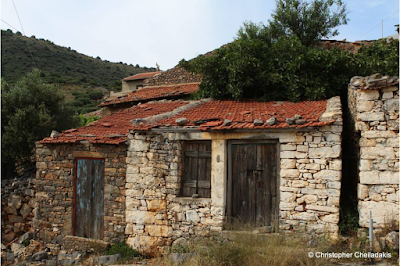
Published in cretanbeaches.com "The settlement of Drakos (i.e. Dragon) is located close to Limnes (Agios Nikolaos). It is one of the several abandoned villages of the area. The last resident left the Drakos in 1979. It is a model of agricultural village with stone houses with tiles, narrow streets, cisterns for collecting rainwater and scattered threshing floors. Opposite Drakos it is also worth visiting the deserted settlement Dyo Prini (Two Oak Trees). A stone paved road crosses a small oak wood. Near Drakos ancient pottery has been found and it is believed that there was a settlement since ancient times. Only the church of St. Andrew is still well preserved. The architecture of Drakos and was a candidate background for filming the famous Greek series “The island”. It was not chosen because of the difficulty of access through dirt road starting from Limnes." To view photographs of the village -  https://www.cretanbeaches.com/en/tradition/architecture/abandoned-set...

Deserted Villages of Crete - SKALIA near Zakros

Image
Deserted Villages of Crete - SKALIA near Zakros Posted by the website CretanBeaches.com  https://www.cretanbeaches.com/en/history-of-crete/forts-and-castles-on-crete/walled-cities-in-crete/castle-of-skalia-near-zakros "A small castle was located near the village Sitanos of Sitia Region, namely Skalia. Skalia was a small village with a few residents built atop a mountain slope, where the outer walls of the houses formed a wall that surrounded the village, while from the north it was protected by cliffs. The residents of Skalia did usually act against the Turks. Thus, in the middle of the 18th century, the Sultan decided to exterminate them. 2000 Turks were landed at Kato Zakros, guided by a local, recruited by force, and started trekking towards Skalia. However, at night, they stopped to sleep in the area "Mavra Homata". Then, the Greek guide took the opportunity to run and inform Skalians. Indeed, the Skalians ran to the Turkish camp before dawn and massacred al...

Deserted Villages of Crete - ACHLADA

Image
Deserted Villages of Crete - ACHLADA Posted by the website CretanBeaches.com -  https://www.cretanbeaches.com/en/tradition/architecture/abandoned-settlements-villages/achlada " Achlada is one of the nearest villages to Heraklion. Its name is taken after the wild pear tree called ahlada or agoutsakas that abounds here. Ahlada is built on top of a fortified hill above the bay of Agia Pelagia, in an area with a wonderful climate. After many years of continuous habitation Ahlada has almost transformed to a ghost village, despite its proximity to Heraklion. Almost the entire western part of the village and the core consists mainly of deserted houses. While walking through the very narrow streets of the village one can easily understand that the village was built like a fort so as to defend against attacks, especially by pirates. Almost all the habited houses are situated on the east side of the village below the imposing two-aisled church of St. John and St. Tryphon with the ...

Video - Explore the Deserted Village of Kalami Crete (Greece)

Image
EXPLORE THE DESERTED VILLAGE OF KALAMI, CRETE "Once a populous beautiful village where residents used to enjoy the sorrows of life.  Today, this place is forgotten by everyone.  Visitors will encounter open doors and windows, houses remains with objects scattered on the floors and dishes and glasses in position ready to be used again. "The smell of abandonment and melancholy has gripped the village decades ago.  Located 80 kilometers east of Heraklion city in Crete, near Ano Viannos village, this is the village of Kalami.  It is a village set in magnificent scenery, surrounded from mountains, rivers, rivers and dense vegetation, which makes you wonder why they left deserted. "Over 150 families used to inhabit in Kalami before its desertification in the 1970s.  The people gradually came down to the south coast, looking for a better life in Psari Forada and Arvi.  Today, the village remains are the most characteristic monument of rural exodus and has...

FREE - Primeval Greek Village Music 1907-1960 "Why The Mountains Are Black"

Image
This is our culture - "The music of Papou and Yiayia" per John P. Dascoulias, February 2016 WHY THE MOUNTAINS ARE BLACK Primeval Greek Village Music 1907-1960 Most songs now available for FREE on YouTube - SEE BELOW Originally released by Jack White's Third Man Records - "Remastered from the original 78 rpm discs, this set contains 28 previously unissued recordings" Songs on this album - Links to YouTube Kalamatianos (Dance of Kalamata) -  https://www.youtube.com/watch?v=tI_Ty4QA0PE Sousta Rethymniotiki (Sousta Dance of Rethymno) -  https://www.youtube.com/watch?v=oIup9a61VUA Giati Ine Mavra Ta Vouna (Why the Mountains are Black) -  https://www.youtube.com/watch?v=Tpf7QhyYcoM Ousak Tsiftelli (Tsiftelli Rhythm Dance in Ousak Mode) -  https://www.youtube.com/watch?v=Pp_lnCDDIhg&t=7s Enas Aetos (An Eagle) -  https://www.youtube.com/watch?v=z9qyeY1WNK0 Mirologi-Epirotiko Makedoniko (An Epirotic-Macedonian Lament) -  https://www.yout...

Central Public Library of Rethymnon, Crete, Greece

Image
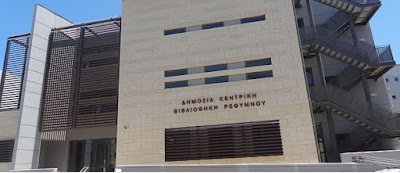
LIBRARY:  Central Public Library of Rethymnon, Crete, Greece The Central Public Library of Rethymnon is one of the largest in Greece and the only public library in Crete.  The library is equipped with two mobile libraries which bring books to even the most remote and isolated villages in Crete.  In the 60 years of operation, the Public Library of Rethymnon has flourished.  Today the collection reaches 200,000 volumes of books, 10,000 volumes of periodicals, as well as a rich archive of local and Athenian newspapers. Website:   http://www.libret.mysch.gr/ Facebook:   https://www.facebook.com/dimbibl.rethimno Contact information:   Address: St. Biris 6 Rethymno 741 00  Phone: 2,831,029,215  Email: libret@sch.gr